“Not my soul”: exhibition compares colonial and ancient slavery
Source: DutchNews.nl
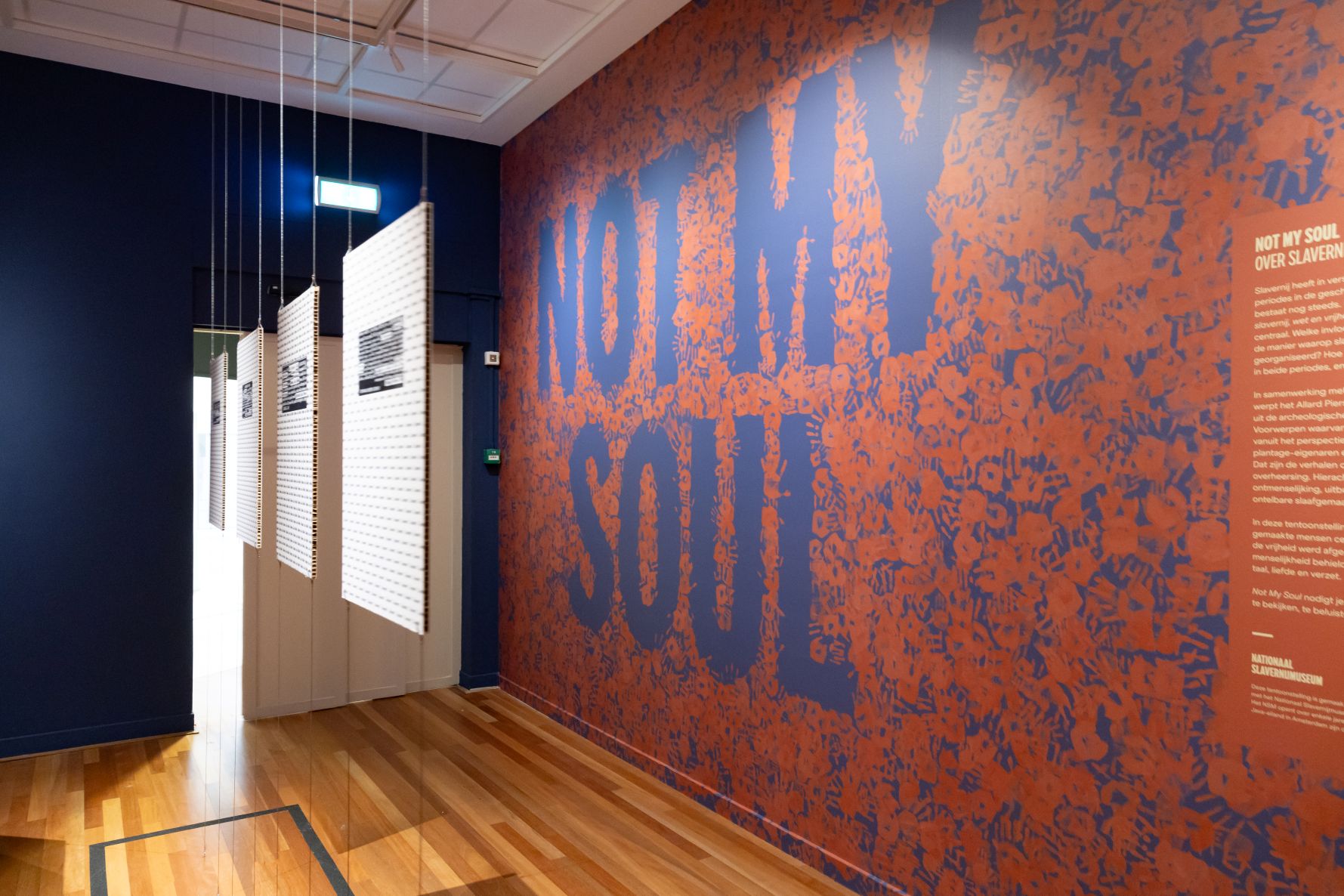
At first it looks like wallpaper. On second glance, you see the imprints of hands, stamped in red paint and climbing up the walls.
This is the opening of a new exhibition on slavery in both Roman and colonial times – and how the laws created for one were later used to justify and legitimise the other.
Not My Soul, open at the Allard Pierson Museum in Amsterdam and running until May 24, has been made in partnership with the planned National Slavery Museum. Using objects from its archaeological and “Surinamica” collections, it analyses slavery through the ages – and its impact today, through modern artworks.
While many records of the enslaved have disappeared, or were preserved only in folklore and song, the exhibition finds clues at the margins of official documents. A signature on the bottom of a piece of Roman pottery is one clue – another is a print depicting Susanna and her two children, who were sold instead of being freed as intended after the master (and their father’s) death.
Isabelle Best, curator of the Surinamese collection at the Allard Pierson, said the wealth of documentation justifying colonial slavery demonstrates a kind of moral whitewashing. “It is important to realise that to dehumanise a person, you have to work very hard,” she said.
“So administration, laws, legal but also religious documents were used during the colonial period as instruments of the state and employed to make a person into a thing. They were published by colonial authorities to put the colonial elite in a situation where they could take ownership of other people and make them into slaves.”
Banned
A room full of Dutch documents referring to Roman laws during the colonial era demonstrates this attempt to justify slavery – despite the fact that vassalage had been banned in the Netherlands. “Actually, they were given a kind of excuse,” said Best. “They didn’t have to take responsibility for their deeds. It was all ordered like this.”
In ancient Roman and Greek times, the exhibition points out, slavery was part of society. Laurien de Gelder, curator of the archaeological collection on West Asia and the Greek world at the Allard Pierson, said that in the latter years of the Roman Empire, some 10% to 30% of people were enslaved.
Although some could earn their freedom, many could not – and no real stories have survived about groups such as those mining silver and precious metals in appalling conditions, she said. But while administrators in colonial times pointed to Roman slavery to justify transporting African and Asian people as slaves, in the Roman period, slavery was not racialised.
“There were enslaved people from Nubia, in the south of Egypt, for example,” she said. “An enslaved person of colour was seen as ‘luxury goods’, something exotic…But systematic exclusion on the basis of skin colour is really a characteristic of transatlantic slavery.”

The exhibition puts stories of enslaved people in the spotlight – the gravestone created by a Roman father for his son, who died two years before he would reach the age of 30 and freedom, for example.
A replica of Jean-Baptiste Carpeaux’s statue “Why born enslaved?” captures, and sexualises, the resistance of a young black woman. Other people “recorded as inventory” include Flora, resold as a young girl for 140 guilders in 1763. But there are also news reports of uprisings and maps of areas of Suriname taken by free people known as Maroons, who had escaped some of the “cruellest plantation colonies”.
Inge Scheijde, spokeswoman for the Allard Pierson, said the show was a “taster” of content in the National Slavery Museum, to be built on Java Island. “Our collection comes from the perspective of the white oppressor, but for this exhibition, we have researched the stories of the people hidden behind it,” she said.
In the middle of the first room are four works from the art series Fugitive, where historian Karl Bergemann and forensic artists Kathryn Smith and Pearl Mamathuba reimagined the faces of enslaved people. Their owned and branded bodies are recorded as lost property in the 19th century newspaper reports on the back of the images.
And on the wall are the words in Sranan Tongo, one of the Surinamese languages, which were sung by Jeangu Macrooy in the 2021 Eurovision song contest: “Yu no man broko mi”. You cannot break me.
The original article: belongs to DutchNews.nl .