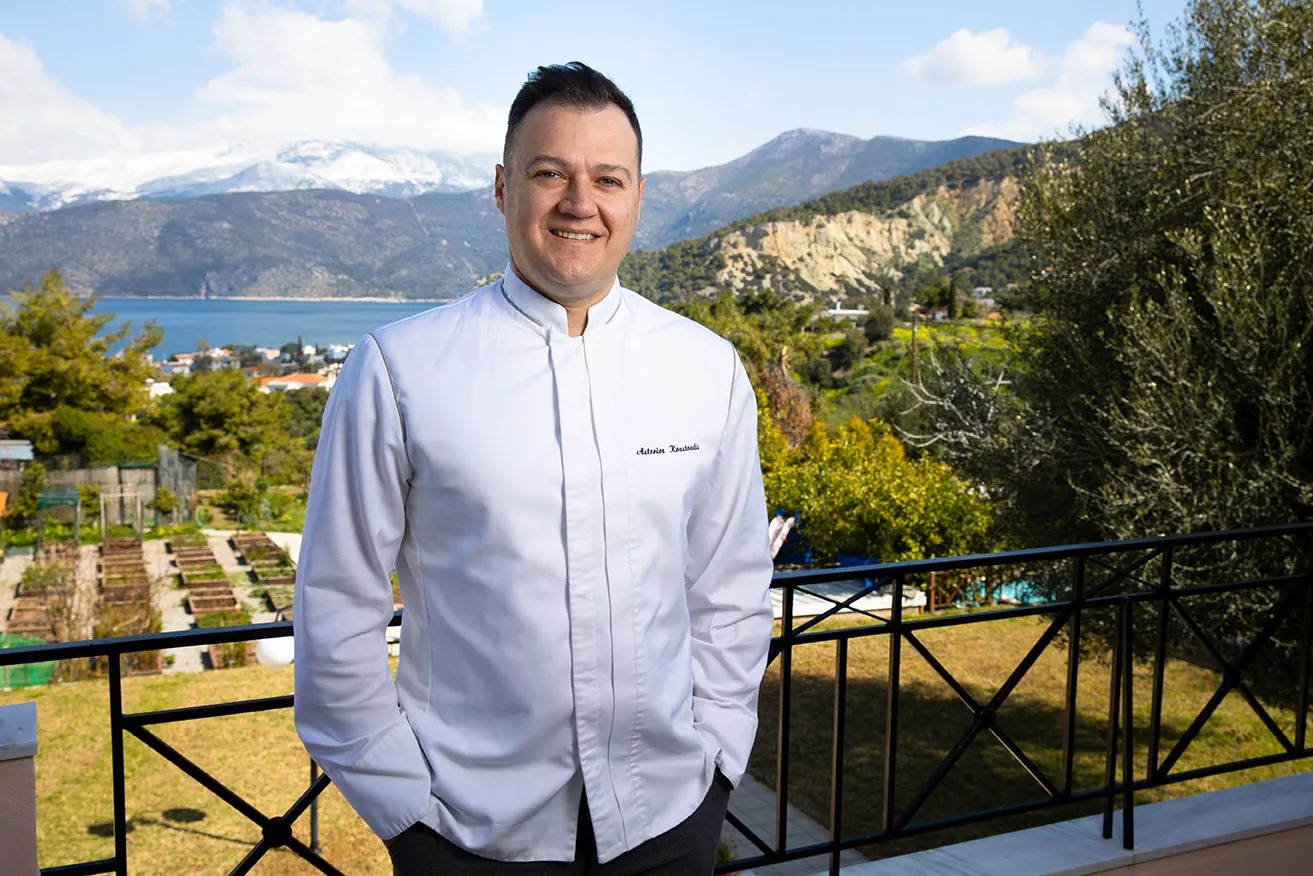
Asterios Koustoudis: Who is the award-winning chef cooking at the Golden Chef Hats Cyprus?
Source: in-cyprus.com
One of the leading figures of his generation, the executive chef of Athens’ iconic Grande Bretagne and King George hotels treats deliciousness as synonymous with love and taste as identical to memory.
His fine dining menu for the Golden Chef Hats Cyprus 2025 gala dinner functions as a ceremonial journey through the gastronomy of the past five decades, revealing how in both cooking and life, meaning lies in a past that illuminates both present and future.
I was born in Thessaloniki, in a little street between Kassandrou and Olympiados. My parents came from two villages, which is why we spent a lot of time at our country house in Vrasna as we were growing up. That’s where I had my first contact with nature, the garden, the fields, my uncles’ and grandparents’ animals.
I have vivid memories of my grandfather’s barn with the cows and the milk he would bring for my grandmother to make her famous galatopita, one of the first dishes etched in my memory. A simple sweet made with eggs, milk and rice that you baked in the oven and kept in the fridge.
In the village we always had a hen to get eggs from and an animal for milk. We had, I remember, our vegetable garden where we’d pick the peppers that my mother would fry, with a sauce made from our own grated tomatoes and feta.
It’s important to know what a field means, how much care an animal needs and how difficult it is for ingredients to reach your plate. We would count how many peppers and tomatoes we’d pick from the garden.
We wouldn’t take more, only what we needed. This needs to become lived experience for everyone, not just for us cooks. To have contact with raw ingredients and respect them so we leave something for the next generation too. This is what I try to pass on to my own children.
Today I look behind a recipe. I seek out the ingredients, the producers, I wonder why I should take something and reject something else. Sometimes, when the cooks are looking for me, they make a joke and say “he’ll be with the tomatoes again”.
I have such a great love for ingredients that I go to see them, to cut them, to taste them, to get close to nature and surrender to the tranquillity of colours and aromas.
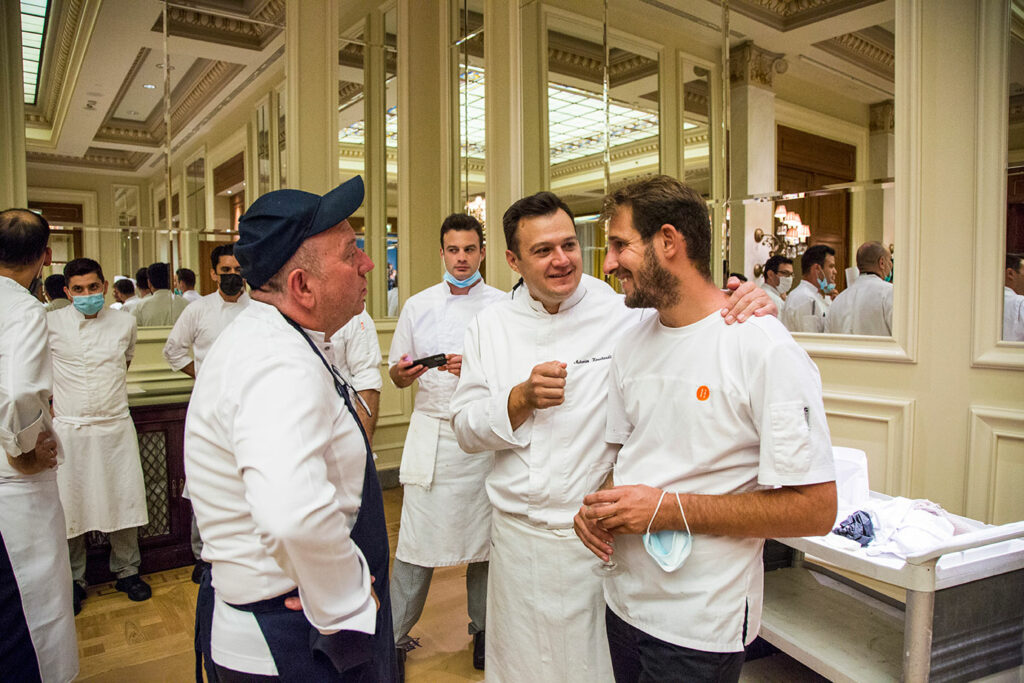
I worked hard from a young age, at a professional pace. And although I’ve done many jobs, I didn’t have it in my mind that I’d become a cook. What led me to this was the thought that whatever I created, I wanted to see it immediately.
To make it and know straight away how good it was, and if I didn’t do something well, I could fix it the next time.
I was lucky because I found myself early on in organised, structured, five-star city hotels. I’ve been through the Macedonia Palace and the Electra Palace, then I came down to Athens, to the excellent boutique hotel Pentelikon in Kifisia, which changed the course of my career.
A hotel with a high level and demanding gastronomic direction. That’s where I was first awarded a Golden Chef and a Michelin star.
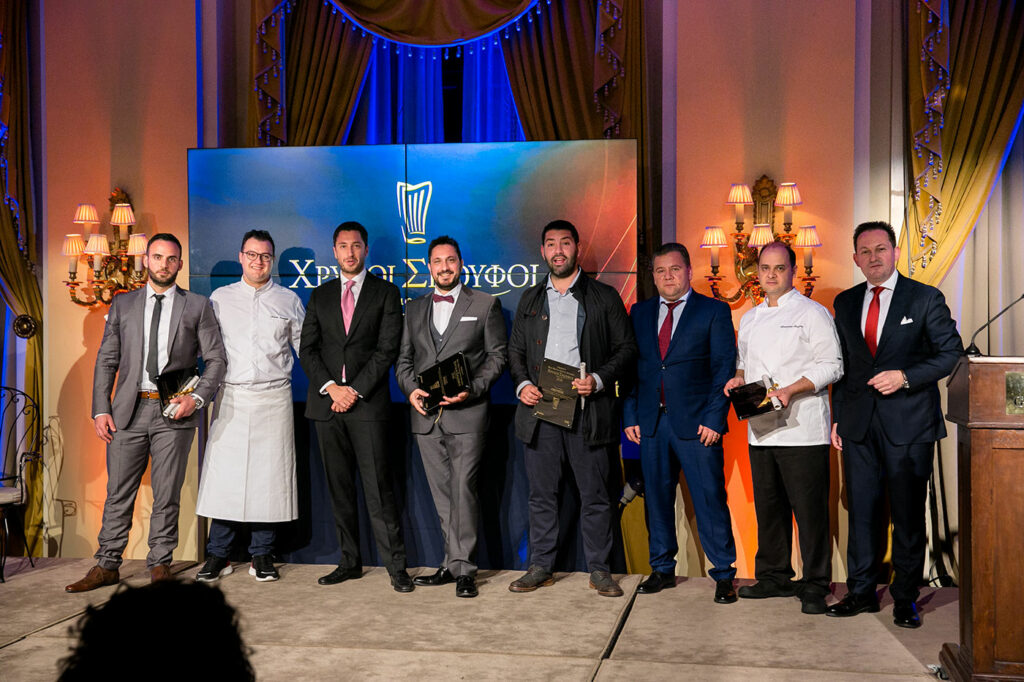
My biggest milestone was the Grande Bretagne, where I’ve been working since 2011. If you think of it romantically, that you’re on a road that leads somewhere, this is the pinnacle. The highest point you can reach as a cook. Not only because it’s a legendary hotel, but also because it’s a place where you can leave your imprint, which will remain engraved in the future.
Last year we celebrated 150 years and as part of the celebrations we screened a documentary about the history and the importance food had in it.
One of the first owners of the Grande Bretagne, Efstathios Lampsas, was a cook and gastronomy has always been the great protagonist. The responsibility and honour are enormous when you realise that a century and a half later, you’re at the helm of this kitchen and that at some point, you too will become part of its history.
It’s a great challenge when you combine the tradition of an iconic space with contemporary gastronomic demands. Several hundred people dine at our hotels each day.
Someone might have come just for a brief break, someone else for a business meeting, for breakfast, a gastronomic evening, a romantic dinner or they might be the official guest of the Greek government.
The spectrum is so wide that you have to be very careful about what you’ll present, it requires proper thought before you commit something to the plate.
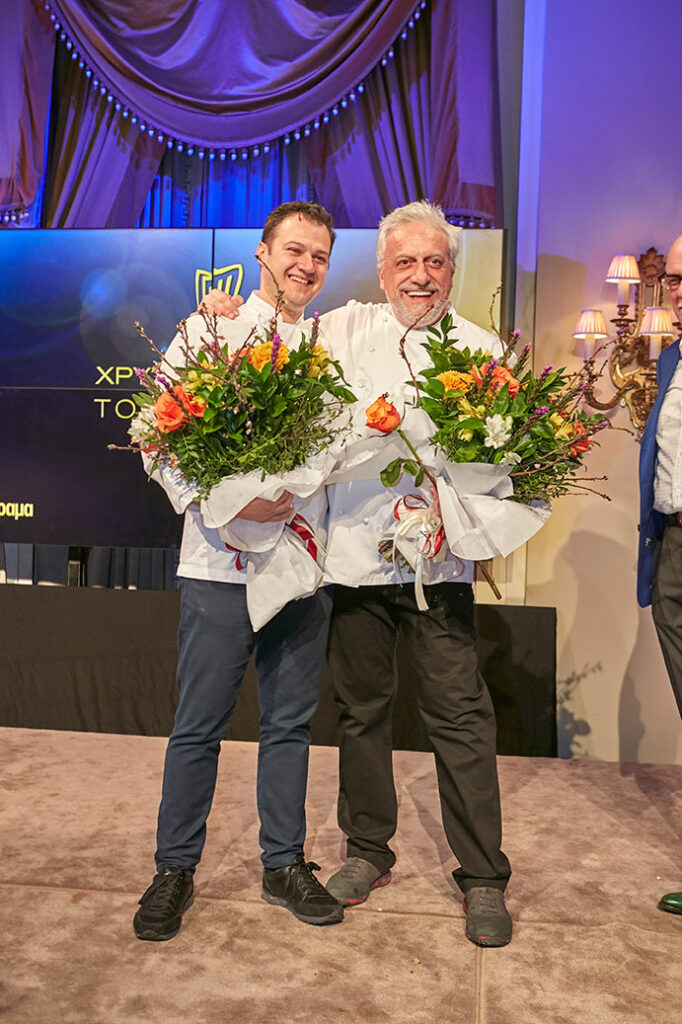

If I had to choose one person to call my mentor, it would be my father. A hard-working man, fair, soft-spoken, with his family as his priority. He’s worked so hard in his life and created everything from nothing, because he came from a poor family.
From him I take the strength he had to raise three children, as well as the principles and values he taught us. Principles that today are reflected in my cooking.
As a chef, you have to be fair, hard-working, listen, reward and be the example for others yourself. “Lead by example”, as they say. And my father was and is my own role model.
I dedicate many hours a day to the hotel. When I’m away, family is my priority, my wife and my two children. I’m happy because we’re close and I, like my father, have made sure we can make plans for tomorrow too.
I’ve won a total of 18 Golden Chef Hats in my career, starting from 2010 when I was awarded for the Vardis restaurant at the Pentelikon hotel. From 2017 until today I’ve been winning consistently for the Grande Bretagne restaurant (GB Roof Garden) and from 2018 until today for the King George restaurant too (Tudor Hall).
I was a kid, 30 years old, when I got my first Michelin. We worked hard for it and were very focused on achieving the goal. But I was young, trying to keep my feet on the ground. When you’re young, awards give you strength, motivation to succeed.
When they come, you’re filled with joy, you see things optimistically, you say “I’ve achieved something, so I can accomplish other things too”. But that doesn’t mean you’re absolutely successful. You’re successful when you have an excellent trajectory, mental balance and you enjoy your daily life, your cooking.
When it happened, I realised it’s also an enormous responsibility. You enter demanding rhythms, there’s no room for mistakes, bad days. If the restaurant isn’t awarded again, some people interpret it as failure. Over the years, I discovered that we’re wrong to have in our minds that the award is the be-all and end-all.
We’ve heard many times about chefs who gave up awards and got involved, for example, with the land. Which, I won’t hide from you, I’ve thought about too. Today I have the joy of leading a team that wins awards and to be awarded at two different hotels is an enormous achievement.
But on the other hand, I show my team that it’s not the only goal. We need to focus on hospitality, on quality, consistency, on the customer themselves, and when it combines with awards, that’s the ultimate.
Time for us cooks at the Grande Bretagne always counted from the day of the Golden Chef Hats gala dinner. It would start from the day of the ceremony until the next year when we’d arrive again at the day of the event.
It’s the ultimate event, the ultimate dining experience from a cooking and restaurant perspective. You’re cooking for people who are in the industry and you’re addressing people who know how you’ve cooked, how you present it. The level and expectations for that evening are extremely high.
Having overall responsibility for the Golden Chef Hats gastronomic gala dinners for many years at the Grande Bretagne, I’ve worked closely with many of the great chefs, three-starred and multi-starred, major stars on the global gastronomic scene, chefs invited by Anni Iliopoulou (the creator and head of the institution) and the Golden Chef Hats tasting committee.
And you’re here, not only to help them, but to present what they themselves do, in their own space. And we’re talking about service for more than 250 people and a series of dishes from 6 to 7, meaning around 2,000 plates in total, which must come out at a high level, as the guest imagines it, but also according to what the Grande Bretagne represents.
I used to watch, when I was younger, Marc Veyrat and think “how will this chef present his cuisine for 300 people at the Golden Chef Hats?”. Ultimately, chemistry is the key to success.
To manage to work with this chef, his team and your own cooks, to help them work together, when they might not even speak the same language. It proved, however, that nothing is impossible.
When you become part of the organisation, you feel proud of everyone and at the same time emotionally charged, because you’ve managed to host a chef who will return to his country and talk about your hotel, about the Golden Chef Hats, about Greece.
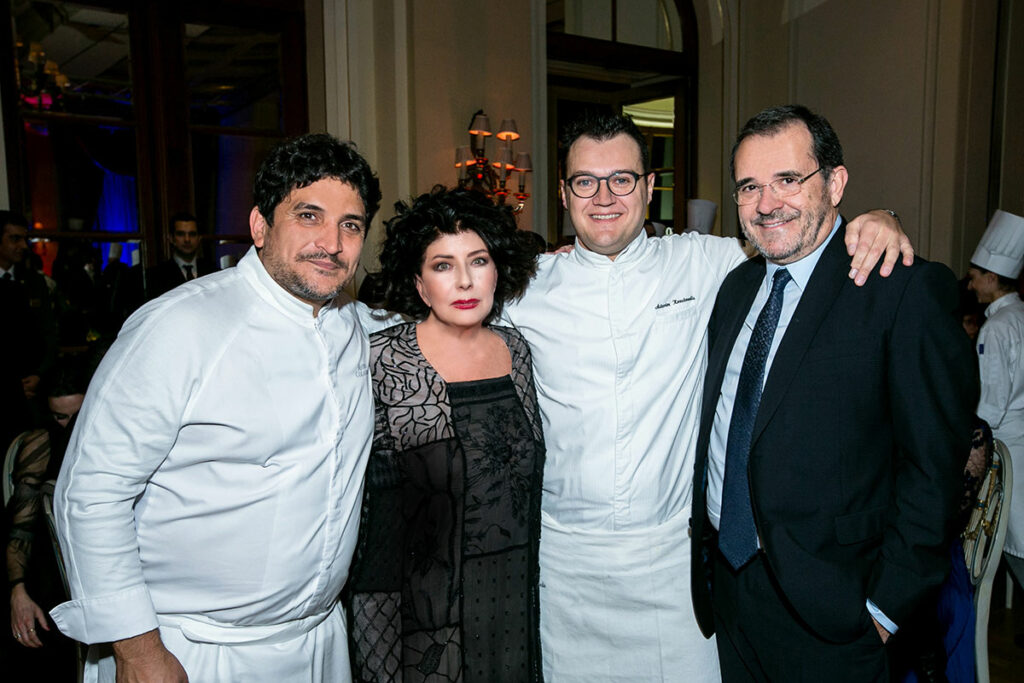
Martin Berasategui was the guest chef when I started working at the hotel. One of the most classical chefs, an exceptional presence. I won’t forget the then-rising and now enormous Björn Frantzén who had come from Scandinavia either.
He’d made, I remember, a cod, and just seeing the iridescent colour when it came out of cooking, you’d say “how is this possible?”.
In 2020 Mauro Colagreco cooked, from the Mirazur restaurant, at his peak, with three Michelin stars, the best restaurant in the world at the time and the best chef.

A chef who didn’t stand out from the other cooks – he was next to you, cooking, sweating, had rhythm and passion. A warrior-chef with education, who’s always in the kitchen.
Davide Scabin, this great Italian chef, presented perhaps one of the strangest dishes we’ve ever made at the Golden Chef Hats: Meat from the fireplace. “OK, what is this meat from the fireplace, how will we make meat from the fireplace?”, I wondered.
Well, he’d taken a Fassona fillet, breaded it, fried it and then placed it in a vessel with aromatics and when he lit the fire, it took on a smell, as if it was smoking in the fireplace. When I asked him how we’d eat this, he answered “with your hand”. “Are you sure?”, I asked and he answered affirmatively, “because when we serve food from the fireplace at home, we enjoy it with our hands”.
The most subversive thing, though, was that we started backwards. We served the main course first and then went to the starter. Because he believed that when we’re very hungry, meaning at the beginning, we should enjoy the most wonderful and heaviest dish. That was his philosophy. We followed it and enjoyed it!
Unforgettable too were the events with the whole Greek National Team, the “old guard” and the new generation. It was very moving to see one year the oldest chefs in Greece cooking and then the young kids, our age at the time.
The same with the year when our chefs from abroad were invited, Giorgos Papazacharias, Filippos Chronopoulos, Thanos Feskos, Michalis Papafilis and Giorgos Kataras. Kids who worked in three-starred restaurants abroad and who came to Greece to present one dish each at the Golden Chef Hats. It was fantastic!
For me, deliciousness is synonymous with love. And Cypriot cooking is a cuisine of warmth, with lots of flavour. Reading its history, I retained some very beautiful elements.
For example that you’re an island that worked a lot with pottery. You made cooking vessels, ceramics in which you baked your food, which is perhaps my favourite method, to cook something slowly in a vessel.
It’s a great honour that I’ll be at the Golden Chef Hats Cyprus this year. We’ve created a menu that will journey from now to then. What we tried to show is that although now we might be tasting something in a modern version, its history and recipe might start from a classical recipe.
What we’ll do represents the pinnacle of a chef’s maturity. It requires experience to reach the point of presenting classical cooking at a gala dinner. With beautiful raw ingredients and simple cooking, to present something exceptional. There’s great allure in classical cooking, but you have to do it perfectly. Otherwise it has no meaning.
The differences between a classical dish from the past and the contemporary era are considerable. First of all, the ingredients have changed, healthy eating has become part of our culture now, whereas once they might not have had it in mind at all.
Also, the philosophy of service has changed, of presentation, just as the philosophy of the people eating has changed. But the common denominator is cooking.
Cooking is one and will never change. It requires balance, though. Not to go to extremes and not to lose the character of the classical, trying to tamper with a recipe and make it more modern.
There’s a reason the classical has become current and it’s not only to do with cooking. People look to the past to find the solution for now. History is what shows you the way. Whether someone did something right or not.
You self-reflect. Where am I, where have I got to, should I continue like this? Maybe I need to look for something more different, something more classical that has more meaning? Because the modern is also ephemeral. Modern is today and in two years it will no longer be in fashion, something else will come. But the classical will never go away.
With the passage of time, I’ve matured. That craziness has gone, the cloud in your mind, when you’ve got things a bit muddled and you want to prove things because you have ideas, appetite or big expectations.
Over the years I’m becoming more reductive in my recipes. As you grow, what you commit to your plate must be more structured, with a beginning and end. And ideally, it should have your identity, someone should be able to recognise that it’s yours.
I’d like my dish to be “clean”. With balanced flavours, clear direction and a result that “speaks” to memory. When you close your eyes, that is, you say “I’ve eaten this before”.
Taste is memory and I don’t think there’s a person in the world who could say that isn’t true. My goal for the Golden Chef Hats Cyprus is when the guests close their eyes, their memory takes them to something they’ve eaten in the past.
There’s no more beautiful feeling when your food speaks to a person’s taste memory. If I achieve that, I’ll go back happy, with a smile.
GOLDEN CHEF HATS CYPRUS 2025
The biggest and most credible gastronomic institution awarding the best restaurants in Greece and Cyprus comes for the fifth year from Athinorama and Phileleftheros, on 26 November at the Four Seasons hotel in Limassol.
EVENT SPONSORS
Presented by: Eurobank
Gold sponsors: CIC Mercedes-Benz, Nespresso, St. Pellegrino & Acqua Panna, Nico Lazaridi, Famille Perrin, Champagne Jacquart, Staropramen Beer, Mövenpick, Tamdhu whisky
Hospitality: Four Seasons Hotel
Ingredients sponsor: Amaxulus
Organisers: Athinorama, Phileleftheros
Read more:
The original article: belongs to in-cyprus.com .