Michaela Loukas wins young scientist of the year for early breast cancer detection
Source: NEOS KOSMOS
Michaela Loukas has the world at her feet. Having just finished Year 12 at Marist Catholic College Penshurst, her incredible achievements are making her parents and family proud, and rightly so. Michaela is no ordinary teenager.
On Friday she took home the Young Scientist of the Year Award for NSW. Her mother, Maria Rallis, told Neos Kosmos: “Michaela took out the first-place prize in her category (biology) but to our totally unexpected surprise she took out the grand overall prize of 2025 Young Scientist of the Year and is going on to represent NSW at the national level.”
The NSW Premier, Chris Minns, has referred to her as a medical trailblazer, and she already has conditional offers to study at UNSW, including a double honours degree in Engineering (Bioinformatics) and Science. She has also been shortlisted for an Engineering scholarship.

The world is not just at her feet it is ready for the positive changes Michaela is preparing to make. These changes are evident in her ethos: pushing for earlier detection of major health issues, advocating for medical affordability, and supporting women to take their place in Australian science. Michaela notes that in Greece, female representation in STEM is almost equal to men, while Australia sits at around 31 per cent.
“As a young woman from a cultural background, my hope is that the visibility of winning encourages other girls to see themselves in STEM too, representation matters in a male-dominated field in Australia.”

When I spoke to the family, I heard more about Michaela’s early achievements. Her parents met on Lesvos in the 1990s when Maria was working on a documentary and Themis Loukas was undertaking his military service. Their children were born in Athens, and the family migrated to Australia in 2012.
At just 15, Michaela co-engineered a robotic melanoma screening prototype with a classmate, designed for early detection in rural communities. The prototype led to an invitation to Silicon Valley to showcase the project, an opportunity Michaela declined so she would not miss three weeks of school.

She used LinkedIn as a key tool for networking and engagement, something her mother points out would have been impossible under the proposed youth social media ban, a policy that would have negatively impacted the then-15-year-old’s opportunities.
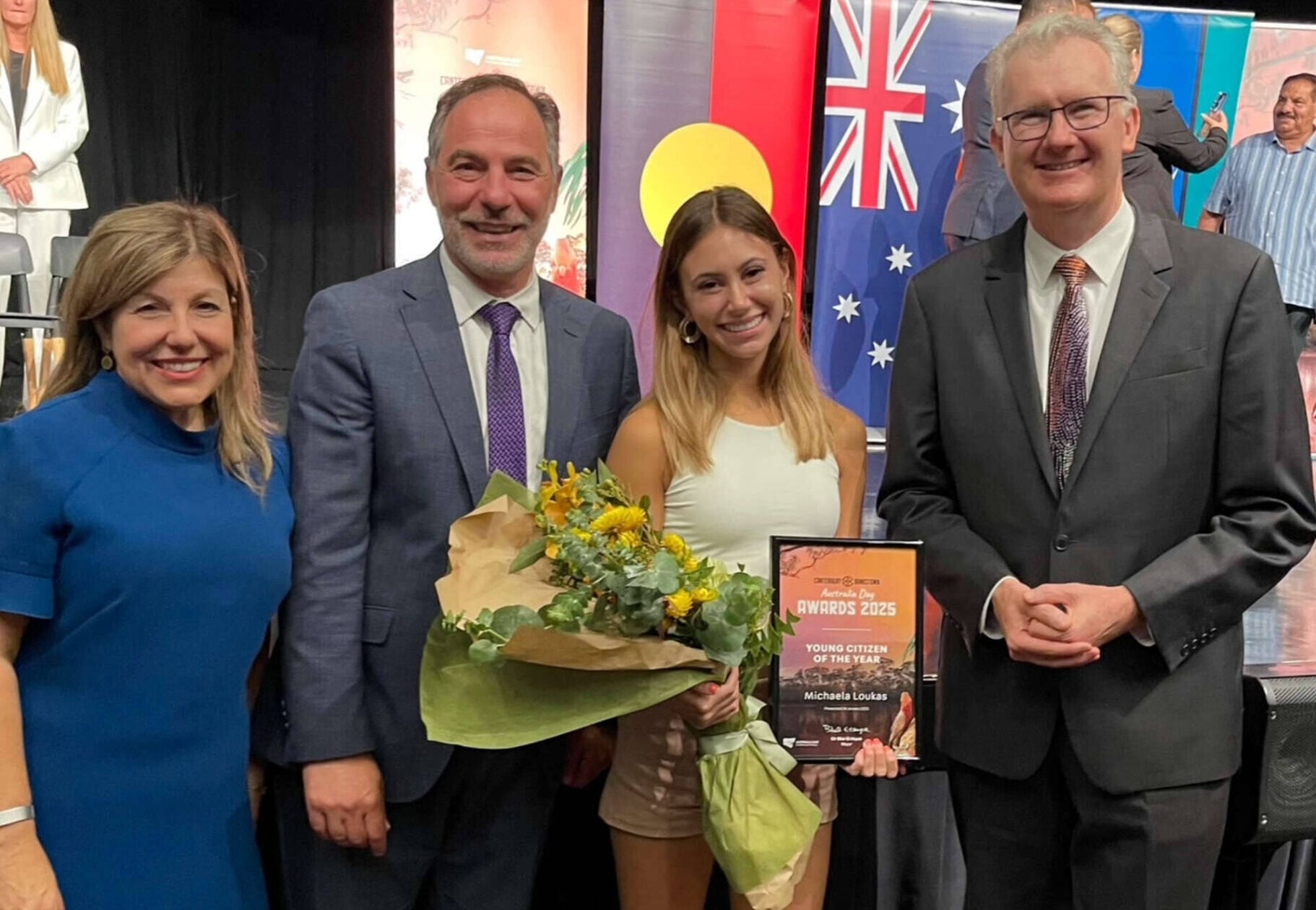
Michaela has since won multiple awards, including the Zonita Young Woman in Leadership Award (2024), a place in the Top Four 7News Young Achiever Awards in the Ministry of Health category, and a local government award. Earlier this year she was also named Canterbury-Bankstown’s Young Citizen of the Year by Mayor Bilal El-Hayek, who has openly praised her work. Equally proud is Canterbury MP Sophie Cotsis, who has known Maria since their days at Macquarie University. Both women share Lesvian heritage as well as ties to the Canterbury area.

Reflecting on the Canterbury award, Michaela told me, “Winning Young Citizen of the Year was an incredible honour! I had the chance to speak with government ministers and community leaders who are genuinely interested in hearing about my projects.” That interest is only growing as this young scientist continues to shine.
The newly crowned Young Scientist of the Year is earning her accolades through hard work, focus, and determination. Michaela explains that maintaining “balance” in Year 12 is a myth if you want to achieve big goals. She sacrificed time and a social life to pursue her studies and projects and it has paid off.

In 2023, while she was sharing her ideas on LinkedIn, Michaela was headhunted for a competitive UNSW coding program. She won first prize, and her leadership saw her appointed team leader. This experience became the catalyst for her interest in AI and coding. She also completed a Science Extension unit at school as the sole student, learning lab techniques and research skills to prepare her for university-level work.

Michaela’s strong community focus, including work with elderly groups, has shaped her awareness of health inequity. Inspired by a friend’s mother who was battling cancer and had to send samples to the US for a $5000 fee, Michaela set her mind on creating a project to detect breast cancer at a very early stage. This became her passion project, launched at the end of 2023.

Unable to find the AI model she needed, she built her own, then wrote a research paper around it.
Michaela is working from the premise that the future lies in personalised medicine, a view echoed by Dr Karol Sikora, one of Britain’s leading medical scientists and the World Health Organisation’s former cancer chief. He has known the family since the 1990s and, upon learning about Michaela’s work last year, was struck by her ability to research deeply and develop solutions to real medical problems. Dr Sikora emphasised to her the need for AI-driven personalised care.

Conventional tests identify 21 genes across one subtype of breast cancer. Michaela’s model examines 5000 genes across four main gene subtypes. Her goal is to create an affordable, effective screening test, a key reason she continues to win awards. While the project is still in development, she is now preparing to build the next stage of its infrastructure.

Michaela has also benefited from the support of two mentors from USYD, a tight circle of school friends and gym mates, and of course her proud family.
As summer begins, Michaela is taking a well-earned break. She will return from a Pacific trip knowing that the world is, indeed, her oyster.

The original article: belongs to NEOS KOSMOS .