The Door~or, if you prefer, at the precipice of an unforgettable Greek migrant
Source: NEOS KOSMOS
Now that I read it again, this ‘once’ sounds rather belated. But what can I do? I’ve reached that part of life where, more often than not, my sentences begin with ‘once’.
Once, we mocked a poem
Let me begin again. Once, we used to mock Maria Bilili-Fotiadi for her poem ‘and the fish held a protest’. Just a line, really, from a poem whose title I can no longer recall. I’m certain, though, that it appears in her collection Conversations with the Wind (Sydney, Diogenes Publishers, 1981).
Acting cultured and sophisticated—pseudo-intellectuals with the awkward humour of youth—we blended that line into improvised narrative quatrains, the sort that go: ‘I walk past your door and you’re frying fish, you throw me a meatball… oh, my eye’ (it sounds better in Greek).
The other bizarre story, I’ll save for another time. Just as I’m saving Manolis Anagnostakis’ epilogue opening-line: ‘these verses may well be the last/The last of the last that will be written’ (‘Epilogue’, trans. Connolly, Epoches, 1945).
A door across time
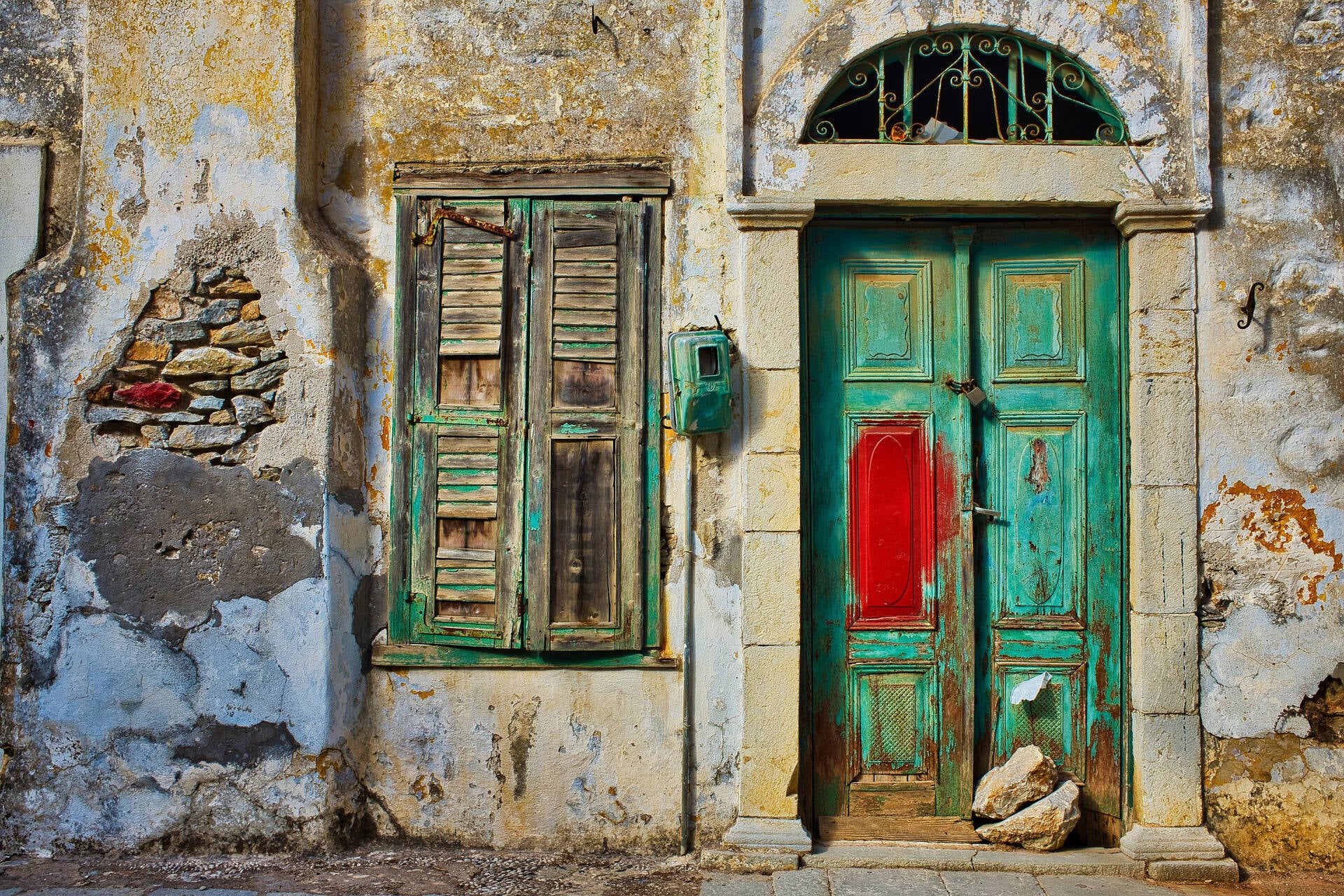
But back to the subject. A few months before the coronavirus curfew, a door—a glass one, front or back, but certainly an exterior door of hard, resilient, timeworn wood—fell, entirely by chance, into my hands. At the time, I was looking for a showcase window to install in the hallway of my daughter’s house, something to spill light into the back rooms. On Gumtree, a young Irishman—new to the neighbourhood, three streets from mine—was advertising it. He had installed a new door in both his house and, symbolically, his life, and now wanted to discard the old one. New beginnings, fresh starts, out with the old—a futurist credo of sorts.
We made contact, strangers in the rain, and I fetched the door in my little 1986 Holden Barina. At first, I only wanted the glass and planned to store the wooden frame. But as I stripped away the old metallic-lead paint, scraping off layers of time, I discovered a ‘canyon’ around the lock packed with pages from a 1970 Athenian newspaper used as putty. Excited, I showed the family, only to be met with the usual: ‘tell us the news, not the weather!’ To be fair, they were preoccupied.
Be that as it may, onward. A Greek door, then. A diasporic door. More precisely, a Greek-Australian door. A door—what a door—once opened and closed by a Greek migrant in the 1970s, and now dislodged by another newcomer before landing, by chance, in my possession. How many hands opened and closed this door? How many did it greet, farewell, surprise, usher in, or shut out—joyfully, sorrowfully, impatiently, indifferently? Suddenly the door becomes a narrator, a chronicler, a keeper of memory. A truly Cavafian, Ithacan door.
Carrying the past forward
Now refurbished, re-varnished, and trimmed to modern measure, it hangs not as an exterior but an interior hallway door in my wife’s family home in North Carlton. The wood was good, so it found new life. It now serves the grandchildren of another Greek migrant, just kilometres from where it once stood. Its putty of half-century-old Greek newsprint hints at an earlier, hidden life. A circular—indeed, re-circular—journey, echoing the migrant story of Australia itself.
In the house where the door now resides, my father-in-law and his young family settled nine months after migrating in 1963. Since he couldn’t drive, he never followed the cousins, koumbaroi, and in-laws to Bulleen, Doncaster, Templestowe, or Balwyn when the Eastern Highway opened in 1977. He stayed in Carlton—faithfully, stubbornly—as the neighbourhood, the world, and his family changed around him. His beloved wife Stella passed away; his daughters married; he remarried; he and his second wife eventually passed on. After a brief interval, his grandchildren—the third generation—returned to the ancestral migrant home—and why not call it their ‘homeland’? This does not diminish the legacy of the original motherland (Lefkada), but echoes it in a cyclical, first-generation way.
Theo disagrees, of course. In his ever-optimistic demur, he rejects the notion of an alternative second-generation homeland. I, however, persist—cynically.
Dual-door dilemmas
And let us not get lost in dual-door dilemmas or treat this ‘door’ as a museum piece. Its meaning lies in its use. When usefulness fades, the object becomes a subject—a mere adjunct. It becomes an earmark of cultural and political subservience. Here, rationalism and realism wrestle—not for our mother’s soul but for an ethical inheritance of thought, feeling, and behaviour. A blemish in the civil register, where each new bout of futurism produces fetishistic eruptions stripped of emotion, leaving us suspended without grounding, worshipping at the altar of technological progress while crashing against tradition and rationalism alike. Politically, though we may wish to remedy injustice, we too easily drift toward the glittering dangers of conformity, unanimity, even the soft seductions of authoritarianism.
And since I opened with a story, let me close with one: a young man, leaving yet another matchmaking meeting, with his uncle calling after him, ‘…and don’t forget to take the door with you!’ And long after everyone and everything else has disappeared, the man—old and solitary—still carries on his back the door that, long ago, became part of his very being.
*Dedicated to my daughter Stella
Dr Michális S. Michael is an academic and author whose work spans international relations, conflict resolution, Australian foreign policy, interfaith and intercultural dialogue, as well as the Cyprus conflict. His research and teaching also explore contemporary Greek and Turkish history, politics, and society.
The original article: belongs to NEOS KOSMOS .