Celebrate the New Year with Greek-inspired recipes
Source: NEOS KOSMOS
As the New Year approaches, Greek kitchens across the diaspora begin to stir with familiar rhythms. Benches are dusted with flour, citrus zest perfumes the air, and families gather around recipes passed down through generations. These shared meals become the inconspicuous rituals carrying memory, faith and hope into the year ahead.
At the heart of Greek New Year celebrations are dishes that combine flavour with symbolism, marking both an ending and a beginning. From the cutting of the vasilopita to the sharing of sweet and savoury favourites, food becomes a way of welcoming the new year together.
Vasilopita
No Greek New Year is complete without vasilopita, the celebratory cake or bread baked in honour of Agios Vasilios (Saint Basil), whose feast day is marked on January 1. Traditionally, a coin is hidden inside the cake, and whoever finds it is said to receive good luck for the year ahead.
There are two popular versions found in Greek homes:
Tsoureki-style vasilopita: a rich, brioche-like bread, often flavoured with mahlepi or mastiha
Cake-style (politiki) vasilopita: lighter in texture, scented with orange and lemon, and dusted with icing sugar or decorated with the new year’s numbers
The ritual of cutting the vasilopita is just as important as the cake itself. Slices are often dedicated to Christ, the Virgin Mary, the home, and family members, before everyone enjoys their share, waiting to see who finds the coin. While vasilopita takes centre stage, other traditional sweets often linger well into the New Year.
Also look into Neos Kosmos’s melomakarona and kourabiedes: the honey-soaked biscuits made with olive oil, spices and walnuts, are a staple of the festive season alongside the almond shortbread biscuits dusted generously with icing sugar, remain a festive favourite, symbolising celebration, generosity and the sweetness of the season on Greek tables.
Stuffed turkey
While roast lamb may be the centrepiece of most Greek celebrations, stuffed turkey has earned a special place on festive tables, particularly during Christmas and New Year gatherings. Introduced through contact with Europe and adapted to local tastes, the Greek version of stuffed turkey reflects the country’s talent for transforming foreign traditions into something distinctly its own.
In many Greek households, especially in urban centres and among families with Asia Minor roots, the holiday turkey is filled not with breadcrumbs alone, but with a rich, aromatic stuffing that mirrors the flavours of the Greek countryside. Rice replaces bread, herbs are used generously, and sweet elements such as chestnuts, raisins or dried figs add balance and depth.

STUFFED TURKEY WITH CHESTNUT AND PINE NUTS
Ingredients:
1 whole turkey
1/2 kilo ground beef
1/2 kilo ground pork
1 cup chestnuts
2/3 cup butter

1/4 cup orange juice
1/4 cup tangerine juice
2/3 cup lemon juice
1/4 cup chopped onion
1/2 cup uncooked instant rice
1/4 cup pine nuts
1/4 cup raisins (optional)
1/3 cup butter
1/2 cup chicken broth
2 tablespoons brandy
1 teaspoon salt
cinnamon and nutmeg to taste
1/2 teaspoon ground black pepper
1 pomegranate for decoration
Method:
1. Preheat oven to 165C
2. Make a small incision on sides of each chestnut, and place in a skillet over medium heat. Cook, stirring often, until toasted. Remove from heat, peel, and chop.
3. Melt 2/3 cup butter in a saucepan, and mix in the orange juice, tangerine juice, and lemon juice. Rub the turkey inside and out with the mixture, reserving some for basting. Season turkey with salt and pepper.
4. In a large skillet over medium heat, cook the ground beef, ground pork, and onion until beef and pork are evenly brown and onion is tender. Drain grease. Mix in the rice. Stir in the chestnuts, pine nuts, raisins, 1/3 cup butter, broth, and brandy. Season with 1 teaspoon salt and 1/2 teaspoon pepper with ground nutmeg and cinnamon to taste. Continue cooking until all liquid has been absorbed. Stuff all turkey cavities with the mixture, and tie in place with kitchen twine.
5. Place turkey on a rack in a roasting pan, and loosely cover breast and thighs with aluminum foil. Pour about 1/4 inch water into the bottom of the pan. Maintain this level of water throughout cook time. Roast turkey in the preheated oven 3 to 4 hours, brushing occasionally with remaining butter and juice mixture. Increase oven temperature to 200C during final hour of roasting, and remove foil. Cook turkey to a minimum internal temperature of 82C.

6. Take out the turkey and let cool for 10′. Place on a platter and decorate with the pomegranate seeds.

Cake style Vasilopita
Ingredients:
3/4 cup unsalted butter, (save some to oil the pan with)
3 cups all-purpose flour, (set some aside to dust the pan with before pouring the batter in)
2 cups granulated sugar
6 large eggs
3 1/2 tablespoons brandy
1 teaspoon vanilla extract
1 tablespoon plus 1½ teaspoons finely grated orange zest
1 1/2 teaspoons finely grated lemon zest
3 teaspoons baking powder
1 cup orange juice
Cacao powder for decorating, coconut flakes & icing sugar, for serving (optional)
Method:
1. Turn on the oven to 180°C on fan or double resistance (top & bottom).
2. Butter and then sprinkle with flour a 10-inch round cake pan, then line the bottom with parchment.
3. You can either use an electric mixer on high speed if you have one or use a beater to hand beat the butter with the granulated sugar for 10 or 15 minutes respectively. Make sure that the butter is in room temperature and soft before mixing it to avoid clumping. Beat until the mix looks soft and fluffy and looks paler than the butter in colour.
4. Lowering the speed by a little start adding the eggs one at a time so that the batter rises. Make sure each egg is fully incorporating into the mixture before adding the next.
5. Once you are done with the eggs add the brandy and vanilla followed by the orange zest and lemon zest until everything is combined.
6. In a separate bowl stir the flour and baking powder to combine.
7. Start poring in the orange juice with mixing the original batter slowly taking breaks to also add the flour mixture gradually.
8. Once the batter feels homogenised pour it in the pan.
9. Wrap a coin in foil and drop it into the batter making sure the top of the pan is smoothed out with a spatula before you bake it.
10. Bake for 60 minutes.
11. Stick a toothpick or tester through the body of the cake to see if it comes out clean. Let the vasilopita cool in the pan for 10 minutes and transfer onto a wire rack or plater.
12. Dust with the cacao and garnish with the icing sugar and/or coconut flakes on top before serving (optional).
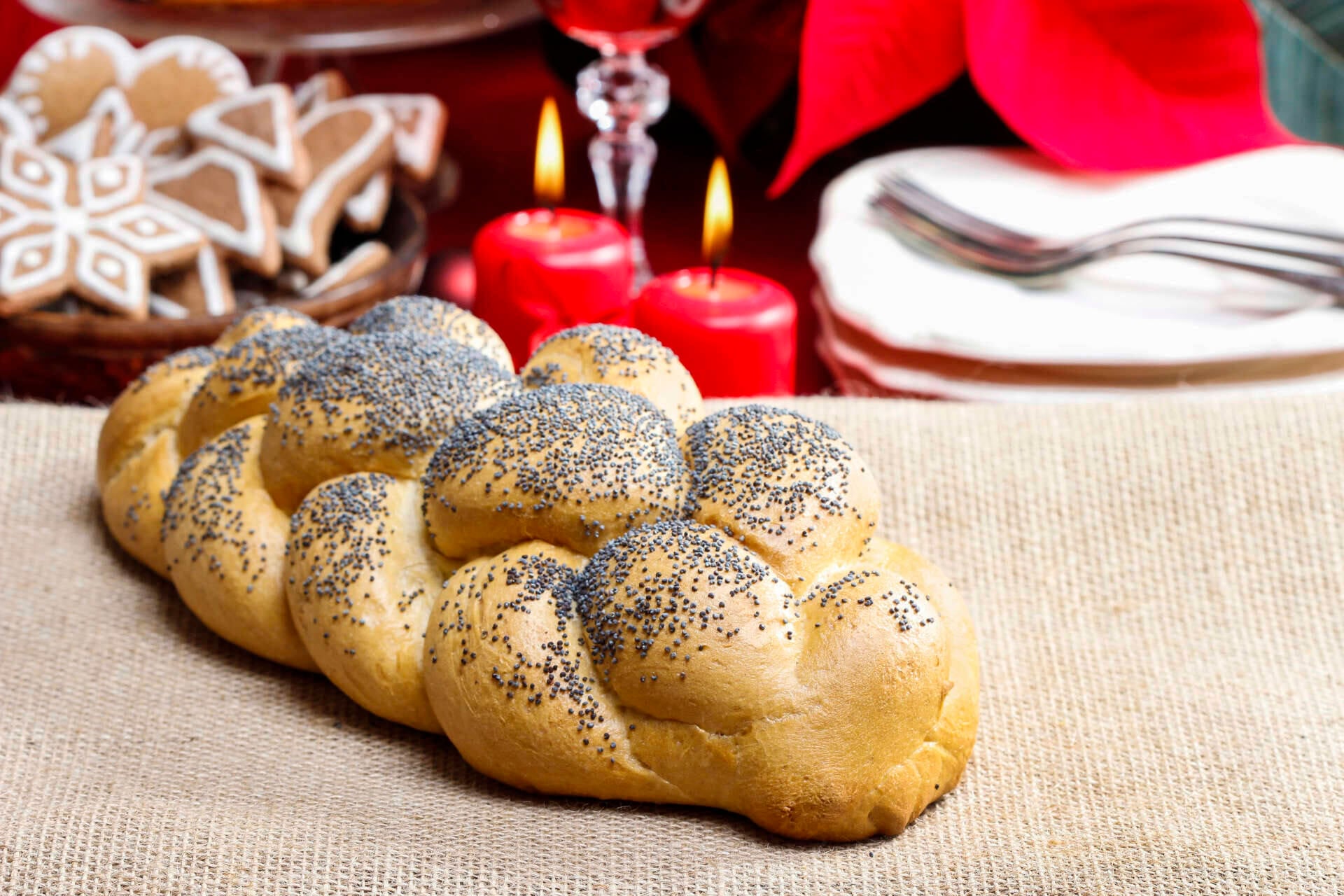
Politiki Vasilopita (Tsoureki, as seen in main image)
Ingredients:
For the yeast
60gr fresh yeast or 16g dry yeast
1 tbsp sugar
75mls lukewarm water
75gr strong bread flour
For Vasilopita Tsoureki dough:
750gr strong bread flour
200gr granulated sugar
180ml lukewarm milk
10ml sunflower oil
2 eggs
75ml orange juice (freshly squashed)
10gr mahlep
1 vanilla pod or 3-4 drops of vanilla extract
1 orange peel
For Vasilopita Tsoureki egg wash
1 egg (egg yolk)
1 tsp water
*additionally you can sprinkle 3 crystals of mastic for extra aroma
wash and wrap the lucky coin with aluminium foil
Method:
1. Add the yeast in a medium size bowl, followed by 1 tablespoon of sugar, 75mls lukewarm water and 75gr strong bread flour
2. Mix the ingredients for 2-3 minutes
3. Wrap the bowl with cling wrap and cover it with a kitchen towel. Leave the dough to rest for approximately 20 minutes near a radiator, in the sun or a warm stove. During this time the mixture will more than double in size.
4. In another large bowl add the sugar with the eggs and whisk them for a couple of minutes. Add the lukewarm milk, orange juice, orange peel, sunflower oil and vanilla. Whisk the ingredients for a couple of minutes. At this point, start adding the flour, mahlep and the yeast (risen dough/yeast). Leave the whisk aside and start mixing the ingredients by hand. Kneed the dough for approximately 7 minutes. You can also use an electric mixer.
5. Add 1 tablespoon of sunflower oil in the dough and cover the bowl sides with oil. Wrap the entire bowl with cling wrap and cover it with a kitchen towel. Let it rise for approximately 30-35 minutes
6. When the dough doubles in size, knead again for a couple of minutes and shape the dough into a round shape to fit into your cake tin. Do not forget your Lucky coin at this stage! Use a clean coin, wrap it in aluminum foil, and place it in the dough. I add the lucky coin from the base of the Tsoureki
7. Cut enough parchment paper or cookie sheet to cover the bottom of the cake tin and a separately piece for the sidewall of the cake tin. If you do not cover the cake tin with parchment paper the dough will stick into the cake and you will not be able to remove it from the cake tin. Wrap the cake tin with the dough with cling wrap, oil it and let it rest for another 20 minutes
8. Preheat the oven to 170C
9. When the dough has increased in size, brush the surface of the dough with a pastry brush with the beaten egg. Place it in the cake tin
10. Bake the for approximately 40-45 minutes. You can check whether your vasilopita tsoureki is ready with a toothpick .Simply prick the cake with the toothpick. If the toothpick still has dough residue on it when you pull it out, bake for another 10 minutes
11. Allow the vasilopita to cool and decorate as you wish. Sprinkle it with icing sugar or cover it with toasted almonds for garnish.
The original article: belongs to NEOS KOSMOS .