“A big story to tell”: The lives of Holocaust survivor sisters from Thessaloniki to Melbou
Source: NEOS KOSMOS
“We and the Greeks were the last among the last.” —Primo Levi— ‘So This is Man’
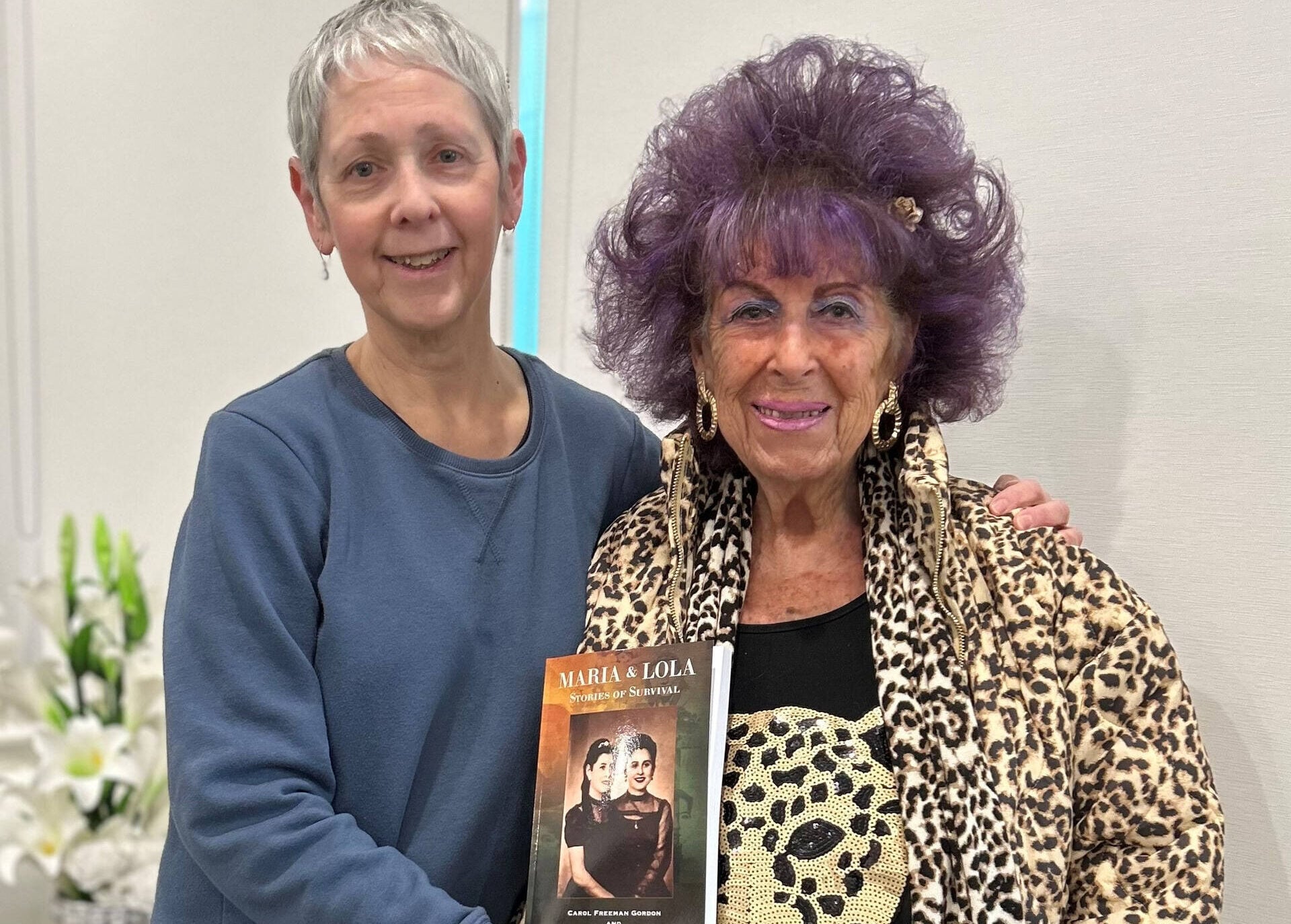
Carol Gordon, Melbourne writer and Holocaust educator, like many Jews, is appalled by what she calls “revisionism” of the Holocaust. A self-described “progressive” Gordon is disturbed by the normalisation of anti-Jewish, anti-Semitic narratives, with the diminishing understanding of how unique and monumental Nazi atrocities were.
“It’s insane – the revisionism we’re seeing now,”.
“And it’s so hurtful to the people I know so intimately who went through it.”
Gordon’s need to ensure truth matters is kernel behind ‘Maria and Lola: Stories in Survival’, a book that was collaboration with Greek Australian educator Gregoria Boursinos. It recounts the journeys of Maria and Lola Seror, two Greek Jewish sisters from Thessaloniki, who survived the Holocaust, made it out of Greece, and post-war rebuilt their lives in Melbourne. Maria and Lola were the only members of their family to survive
‘Maria and Lola: Sisters in Survival’ was launched last Sunday at the Melbourne Holocaust Museum, the book drew an unexpectedly large crowd of around 170 people.
“I was taken aback,” Gordon says. “I was not expecting such a huge crowd. It was thrilling.”

Two sisters, two paths through the Shoa
Maria and Lola Seror, were born and raised in Thessaloniki, the “Jerusalem of the Balkans” as it was known – the Sephardic Jews, arrived after Spanish inquisition, at the height of Ottoman occupation of Greece and the Balkans. They created a Ladino-speaking culture, alongside the older Romaniote Jews of Greece. The city became a thriving hub of Jewish life, commerce, and culture
By the 1920s and 1930s, Salonikan Jews were part of the new Greek nation to emerge from Ottoman Empire’s final collapse from 1913 to 1920. Jews merged with Hellenism, spoke Greek, became citizens, and created a unique Greek Sephardic civic identity—and fought as Greeks against the fascist invading Italians in 1940.
“Most Greeks and Jews lived side-by-side doing the same jobs, sharing the same hardships,” Gordon explains.
“The stereotypes about Jews in Europe simply don’t apply to Thessaloniki. They were unique and they shared the same class position as Greeks.
“Most were working-class or small shopkeepers – leather tanners, tailors, dressmakers, cobblers, dockworkers, and small-time traders. Greeks and Jews were intertwined economically and socially, yet each preserved their own culture,” Gordon says.

Salonika: Greek-Jewish hub
By the 1920s, Salonika had become a truly Greek-Jewish city. Between 1943 and 1945, the community was destroyed and most of Salonika’s Jews, 50,000 Jews were sent to the Auschwitz-Birkenau killing centre. At Birkenau, the SS murdered virtually all the Salonika Jews upon arrival.
For Maria and Lola, survival meant separation, forced labour, hunger, and displacement. Maria died in 2018 at 95, while Lola, now 99, attended the launch of the book, and offered a few words of gratitude—an emotional reminder of how few survivors remain.
Preserving testimony
The book grew out of collaboration between the authors and the sisters. Boursinos, who had met Maria and Lola through the museum, knew that their testimonies had to be preserved and weaved into the fabric of memory. Boursinos spent incalculable hours documenting their stories before approaching Gordon to help shape the material into a narrative.
“She handed me everything,” Gordon recalls. “And I just sat and wrote. There was a big, big story to tell.”
Gordon’s interest in Greek Jewish history is personal. Though not Greek herself, the South African Jewess, was introduced to Greek Jewish stories by Johannesburg’s Greek community.
“I went to Greece when I was younger and felt a real connection,” she says. “Then Greek friends in Johannesburg told me about communities we knew nothing about. I kept going back, visiting places, gathering knowledge. It just grew. My grandmother’s family was Sephardic, so there’s a personal thread too.”
Her work at the Melbourne Holocaust Museum has steeled her commitment to telling true stories, and reminding all of what occurred.
“Every Wednesday I have school groups,” Gordon says. “We’re trying to teach them, to make sure the history is remembered and not coloured by the awful politics going on at the moment.”

Diaspora cultures: Unique, yet parallel
The book is threaded by the weaves and knots that create a complex kinship between Greek and Jewish diasporas. A relationship that often goes back thousands of years.
“For all these years, at all the events, what I’ve noticed is how similar we are,” Gordon says.
“Family values, culture, the importance of tradition—it is so strong in both communities. Religion has nothing to do with it. Most Jews I know are very Jewish culturally, but not religious. Same for many Greeks.
“Diaspora itself becomes a form of identity. You don’t need to be in Greece to be Greek, or in Israel to be Jewish. Culture travels. Both communities are unique in how they maintain language, memory, and tradition while dispersed across the world.”
Remembering for resilience
For Lola, surviving meant living through unimaginable terror, and suffering in the Nazi’s carnival of horror. However, it also meant carrying forward the memory of her lost community. Sitting in the museum’s hall during the launch, she spoke about her gratitude. “I never expected my story to be told to so many people. I am thankful that our lives are remembered.”
With its Melbourne roots, Greek and Jewish immemorial threads, and insistence on truth-telling, ‘Maria and Lola: Stories in Survival’ is more than a historical account. It is a gift—a story that needs to be known. A story of resilience, culture, and the human spirit—for now, and for generations to come.
The original article: belongs to NEOS KOSMOS .