Diatribe: Gender, agency and the nativity icon
Source: NEOS KOSMOS
Among the many images that have shaped the sacred imagination of the Orthodox world, none appears more deceptively familiar than the icon of the Nativity. It enters our homes each December with comforting inevitability and seems to present an uncomplicated tableau of divine incarnation. Yet when examined through the optic of feminist theology, the Nativity icon reveals itself as an intricate field of contested meaning. It is a visual locus where tensions of gender, authority and embodied holiness are negotiated across centuries of artistic and theological tradition. As Elisabeth Schüssler Fiorenza has argued, Christian iconography frequently encodes patriarchal patterns within familiar sacred narratives, patterns that become perceptible only when the viewer approaches the image with critical attentiveness. The Nativity icon is no exception.
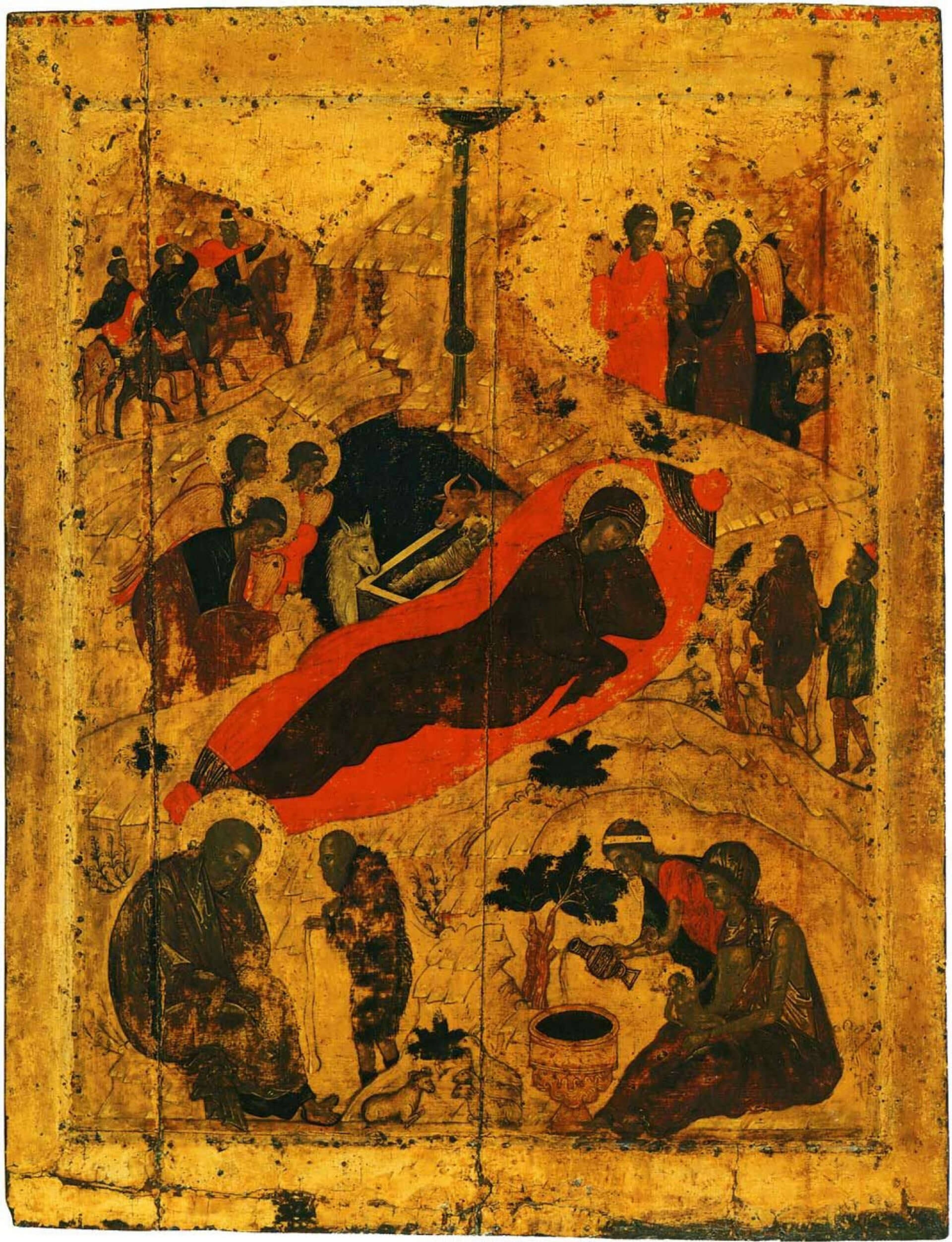
A central insight of feminist theology is that women within Christian tradition are often present yet structurally muted. The Nativity icon both conforms to and disrupts this pattern. In its canonical form, the icon places the Theotokos at the centre of the composition. Her reclining body, inscribed within the hollow of the cave, forms the focal point toward which all other narrative fragments converge. Although the image contains angels, shepherds, midwives, Magi and Joseph, the eye repeatedly returns to the serene figure of Panagia. Her centrality is not incidental. It constitutes a visual proclamation of her agency within the mystery of the Incarnation and signals, as Schüssler Fiorenza would suggest, a space in which women’s bodies are recognised as bearers of salvation history rather than passive conduits of divine will. Her silence functions as a mode of knowing, a chosen stillness that counters the kyriarchal silencing historically imposed upon women.
This Marian centrality becomes more pronounced when set against the long history of male anxiety surrounding the virgin birth. The Protoevangelion of James records early Christian unease before the scandalous assertion of a virgin mother. Joseph, reduced in many icons to a marginal and troubled figure, embodies this anxiety. He appears seated at a distance from mother and child, withdrawn in contemplation. In Greek iconographic tradition, he is confronted by an elderly shepherd whose distorted posture suggests an unsettling presence. Although Orthodox theology hesitates to identify this figure explicitly as the Devil, popular Eastern interpretation often does. The whispered accusation Joseph cannot silence is that Panagia’s virginity is an illusion. His diverted gaze registers the fragility of patriarchal certainty when confronted by female autonomy.
The Nativity icon thus visualises dynamics analysed by feminist theologians such as Rosemary Radford Ruether in her critique of patriarchal suspicion toward women’s bodies. Ruether observes that whenever women become sites of divine action, male structures of authority respond with doubt, control or moral testing. Joseph, immobilised by uncertainty, embodies this response. Joseph’s disquiet contrasts sharply with Panagia’s composure. She reclines with a dignity bordering on the regal, refusing to yield to destabilising doubt. The juxtaposition constitutes a theological claim. Panagia, not Joseph, becomes the stabilising centre of the Incarnation. She embodies, as Kyriaki Karidoyanes-FitzGerald notes, the capacity of the female body to bear divine grace without surrendering agency or integrity. Her posture evokes the hesychastic tradition, locating contemplative authority, so often coded as male, within a woman whose silence shapes the icon’s entire theological space.
The Protoevangelion deepens this reading through the episode of Salome and the midwife, a narrative largely absent from Western imagination yet retained in Eastern iconography and many versions of the Nativity icon. Positioned discreetly, they bathe the newborn Christ. Rather than being merely domestic ornamentation, their presence asserts, against male minimisation, the indispensable role of women in sacred events. The midwife serves as witness and facilitator of the Incarnation, while Salome articulates anxieties projected onto Panagia’s body. Her doubt, expressed through a demand for physical verification, reflects the epistemological violence enacted whenever women’s testimony is distrusted. Her burned hand, healed upon touching the Christ Child, becomes a sign of restored trust in women’s embodied knowledge and questioning models a feminist hermeneutics of suspicion, demonstrating that critical engagement may itself be faithful.
For feminist theology, this episode is pivotal. Schüssler Fiorenza has demonstrated that early Christian texts preserve submerged traditions affirming women’s authority in revelation, later obscured through patriarchal redaction. Salome and the midwife thus function as iconographic survivals of a female apostolicity. They serve, attend and verify, their authority emerging through embodied experience, care and mutual recognition rather than through hierarchty. The icon therefore resists interpretation as a male-centred drama.
Panagia nonetheless remains the axis around which the icon turns. She is rarely depicted gazing directly at the Christ Child, yet her contemplative posture radiates profound inwardness. Feminist interpreters note that this interiority conveys theological dignity, in contrast to later Western sentimentalisation. In older icons, Panagia appears reflective, occasionally distant. This distance in no way diminishes her. Instead, it affirms her role as the one who receives and interprets the Word. Karidoyanes-FitzGerald argues that her stance invites recognition of the complexity of women’s spiritual and intellectual lives. Panagia does not merely bear the Word. She sustains it within a world that persistently seeks to misunderstand her.
The Nativity icon’s structure reinforces this reading. Orthodox iconography collapses temporally distinct events into a single visual field, forming a theological tapestry. Feminist analysis recognises this as an invitation to view the Nativity as a constellation of relationships rather than a linear narrative governed by male authority. The midwives at the margin, the Theotokos at the centre and Joseph at the periphery create a symbolic geometry that locates female authority at the heart of Incarnation, relegating male uncertainty to its edges.
The cave itself carries feminist resonance. It functions as a cosmic womb from which light emerges, a space of darkness transfigured through the Theotokos’s body. Symbolic imagery of this nature aligns with Ruether’s emphasis on regenerative symbolism associated with the female body across religious cosmologies. Consequently, the icon situates Incarnation within a visual grammar of female generativity.
Above, the Magi approach in procession, their depiction shaped partly by Venetian influence upon the Cretan School. Regal and authoritative, their power nonetheless yields to that of the Theotokos, seated in quiet majesty within the cave. Feminist analysis renders this inversion significant. Male authority travels great distances to honour a child borne by a woman. The visual hierarchy subtly displaces patriarchal ordering.
Modern feminist theology also attends to the icon’s historical permeability. Post-Byzantine softness reflects Italian influence following the fall of Constantinople. Icons are not sealed artifacts but living sites where cultural and gendered meanings converge. This dynamism complicates claims that icons merely transmit static patriarchal norms.
At the centre of a feminist reading of the icon stands the question of agency. The Nativity confers upon Panagia an authority that exceeds patriarchal frameworks: she consents to divine initiative and becomes its interpretive ground. Around her, Joseph’s uncertainty, the midwives’ labour, the Magi’s homage and the angels’ proclamation find coherence. Schüssler Fiorenza’s notion of a discipleship of equals is rendered here in visual form, as the icon articulates an economy of salvation structured through relational participation. As an object of veneration, the icon presents this configuration to the worshipper and gradually reshapes the imagination of authority through contemplative encounter. The agency disclosed here does not recede with the narrative but remains suspended within the icon, awaiting recognition each time it is contemplated. What emerges is a theological anthropology in which receptivity, discernment and embodied consent are revealed as authoritative forms of participation in divine life.
Ultimately, feminist interpretation restores depth long present yet intermittently obscured. It reveals the icon as a space where holiness honours a woman’s body and affirms female authority. Through Panagia, Salome, the midwife and the choreography of gesture and gaze, the Nativity discloses an Incarnation carried by women’s endurance, discernment and strength. Beneath the stillness of the familiar Christmas image lies a drama of gendered holiness, quietly reshaping the world.
DEAN KALIMNIOU
The original article: belongs to NEOS KOSMOS .