Greek documentary festival in Chalkida highlights the living legacy of the Greek Diaspora
Source: NEOS KOSMOS
Showcasing the Greek diaspora’s “voice” and initiatives through cultural events and projects in Greece is a vital and meaningful endeavour, as it contributes to the preservation of collective memory and the strengthening of bonds. Highlighting the distinctive gaze of the Greek diaspora in Greece promotes and enriches dialogue concerning national identity and its expressions. From this perspective, it is important to draw attention to the work of the Greek Documentary Festival (DocFest) in Chalkida on the eve of the new year and to recognise its successful organisation of tributes to the life and work of Greeks of the diaspora as part of its activities over the past three years.
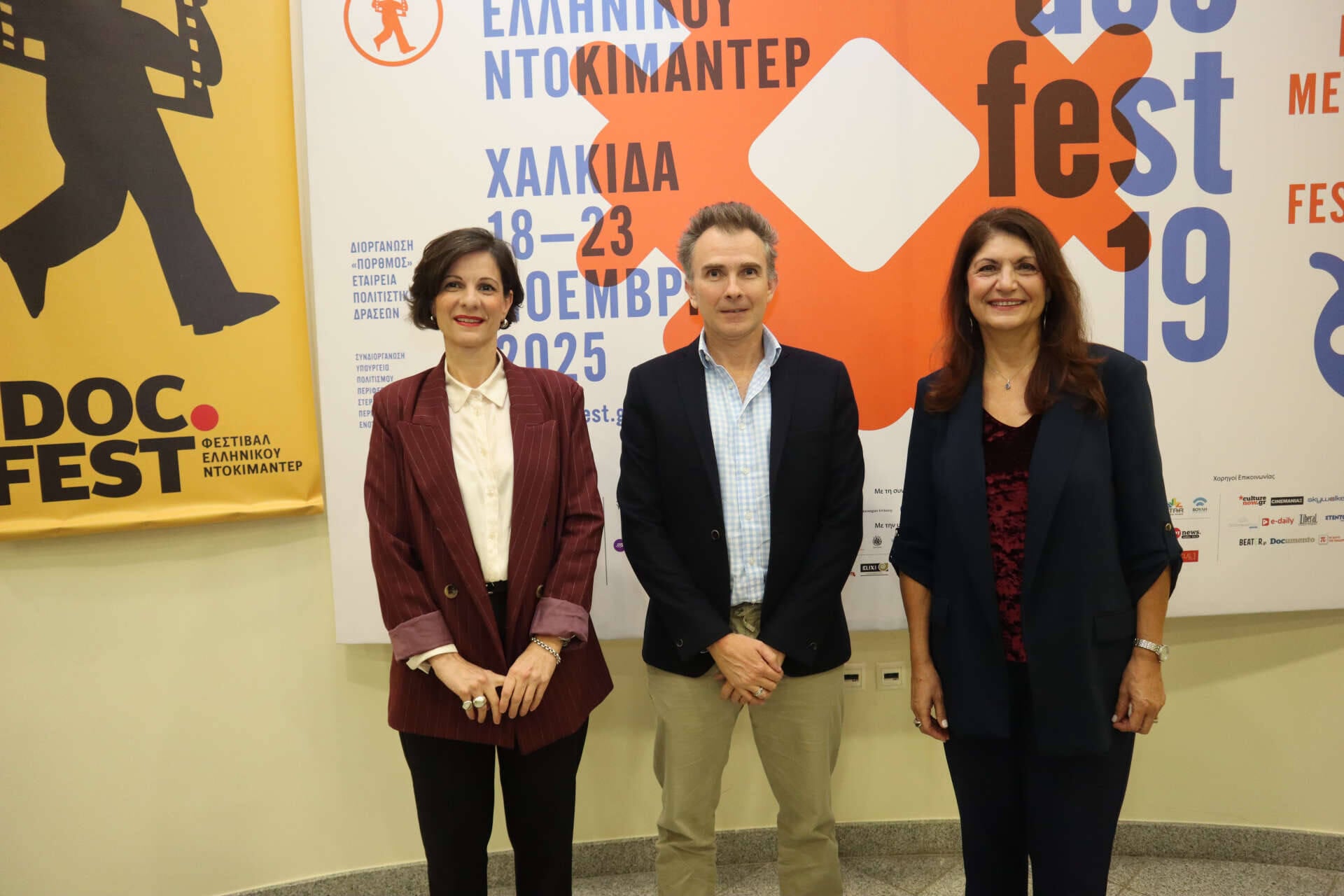
This year, the Greek Documentary Festival (DocFest) in Chalkida included a special tribute to the Greek community of Australia, held under the auspices of the Embassy of Australia and the General Secretariat for Greeks Abroad and Public Diplomacy of the Ministry of Foreign Affairs. The tribute featured the screening of four documentaries: Koupa Piti: White Man in a Deep Hole by Anna Kesisoglou (2007), Anzac: The Greek Chapter by John Irwin and Peter Ewer (2024), Two Homelands by Kay Pavlou (2024), and the sports documentary Ange and Boss: Puskas in Australia by Cam Fink, Tony Wilson, and Rob Heath (2024). Through these films, the tribute highlighted the multiple dimensions of the Greek diasporic experience in Australia, contributing to a broader understanding among audiences.
The tribute also included a thematic panel discussion on the Greek diaspora in Australia and its relationship to Greek cinema, which brought forward theoretical issues and policy-related considerations in the field of filmmaking, generating strong interest among attendees.

Consequently, the DocFest tribute was a great honour for the Greek diaspora of Australia. As a multi-day celebration of Greek documentary filmmaking, storytelling, creativity, and art, the Festival attracts a wide audience. Visitors have the opportunity to attend screenings of Greek and international documentaries, explore painting and photography exhibitions, participate in thematic talks, workshops, and book presentations, and engage in thoughtful dialogue with a diverse range of artists, filmmakers, representatives of civil society, academics, art critics, and other professionals.
The initiative was organised by the Cultural Actions Company “Porthos,” with the Greek Film Centre – Hellenic Film and Audiovisual Media Centre (ΕΚΚΟΜΕΔ) as its strategic supporter. It was delivered under the auspices of the Ministry of Culture, the Ministry of Foreign Affairs, and Europe for Festivals (2022–2023), and co-organised with the Region of Central Greece (Regional Unit of Evia) and the Ministry of Culture of Greece. The official media sponsor of DocFest was the Hellenic Broadcasting Corporation (ERT).

This year’s DocFest programme featured a total of 114 documentaries produced in 2024–2025. In the competitive section, approximately 35 short- and feature-length films participated, covering a wide range of themes. In the “Panorama” section—which showcases films revealing the unseen side of events and produced under demanding conditions—almost 30 documentaries were presented. At the same time, approximately 29 films premiered during the Festival.
To promote youth and student creativity, DocFest, in collaboration with local schools and nineteen universities across Greece, also showcased pupils’ and students’ documentary and animation projects. For photography and painting enthusiasts, the DocFest team organised a photography exhibition featuring the work of distinguished photographer and war correspondent Aristotelis Sarrikostas, as well as a painting exhibition by Alekos Fassianos.
Finally, three engaging thematic discussions were offered to the audience, one of which focused on the Greek community in Australia. Its panel included four speakers from different fields: Dr Eleni Tsefala (actress, director, screenwriter, and postdoctoral researcher at the National and Kapodistrian University of Athens), Maria Filio Tridimas (Coordinator of the Thematic Network for the Greek Diaspora, Institute of ENA), Manos Efstratiadis (director), and Menos Deliotzakis (director and Head of the Directorate for Greeks Abroad, ERT).

Reflecting on her presentation, Dr Eleni Tsefala, in her talk entitled “Diaspora and Cultural Policy: The Greek Community of Australia as an Example of a Multicultural Strategy,” addressed the cultural production of the Greek diaspora in Australia, arguing that it “preserves memory and identity, making the Greek diaspora a living archive of experiences that bridges generations and homelands.” For Dr Tsefala, the cultural output of the Greek diaspora in Australia represents a small part of a polyphonic corpus encompassing war memory, refugee experiences, identity, community, sport, and collective memory. The Greek experience in Australia is not simply a story of migration; it is a living demonstration of a multicultural strategy, where cultural production serves as a carrier of memory, transforming collective experience into cultural capital and positioning the Greek diaspora as an active contributor to multiculturalism.
In this context, Dr Tsefala discussed the work of Nick Giannopoulos and Alex Lycos, who as theatrical creators have also engaged in cinematic projects; the initiatives of Effie Alexakis and Leonard Janiszewski, which integrate oral history, photography, and social analysis; and the work of director Ana Kokkinos, which explores issues of identity, sexuality, and social inclusion through a documentary-style approach. She also highlighted the performance Opou Gis kai Patris (“Where Earth and Homeland”), a theatre-of-testimony piece depicting the experiences of three generations of immigrants, co-written with Konstantinos Kalymnios and directed by Stamatis Tzelepis, which elicited strong interest from the audience.
The next presentation was delivered by me, as Coordinator of the Thematic Network for the Greek Diaspora (Institute of ENA), reflecting on efforts to promote and highlight diasporic culture. Tracing developments from the 1960s–1970s to the present day, and focusing on the Greek Film Festival organised by Greek community organisations with Delphi Bank’s sponsorship, the presentation highlighted the Greek diaspora’s capacity for self-organisation and resilience. In doing so, it offered a concise historical overview that generated strong audience interest.

During the 1960s–1970s, high demand for Greek film productions led to the operation of many Greek cinemas, contributing to the entrepreneurial involvement of migrants of Greek origin in the distribution and exhibition of films from Greece. Decades later, around the mid-1980s, when many cinemas in Melbourne closed, the resulting gap in the screening of Greek films was filled by initiatives undertaken by the Greek Community of Melbourne and Victoria (GOCMV). Greek films were initially screened during Greek Week and later at the Antipodes Festival. In the mid-1990s, the Greek Film Festival in Melbourne was established following a proposal by Eleni Berde, Kostas Markos, and Kostas Karamarkos, marking a series of significant milestones and innovations.
The thematic panel concluded with contributions from director Manos Efstratiadis and Menos Deliotzakis, Director of the Hellenic Diaspora Directorate at ERT. Mr Efstratiadis spoke about the need for ongoing dialogue in Greece regarding diasporic art initiated in Australia, particularly in cinema. Many of the initiatives mentioned by Dr Tsefala remain largely unknown to the broader Greek public, he noted. In this context, Deliotzakis discussed the role of the Hellenic Diaspora Directorate at ERT and highlighted the potential of co-productions between Greece and Australia in promoting both diasporic and Greek cinema. However, this possibility remains distant, as the Free Trade Agreement (FTA) negotiations between Australia and the European Union—which began in 2018—exclude the audiovisual sector, including film, television, streaming, and cultural content. No bilateral agreement covering these areas currently exists. Against this backdrop, initiatives such as the DocFest tribute in Chalkida represent an especially valuable step in showcasing the artistic and creative work of the Greek diaspora in Australia to audiences in Greece.
The tribute to the Greek diaspora concluded with a successful closing ceremony on 23 November 2025, accompanied by traditional Epirus melodies performed by the polyphonic ensemble Chaonia. Among those in attendance was the Deputy Head of Mission at the Australian Embassy in Greece, Mr Lachlan Scully, who welcomed the event and presented an award to one of the films in the Festival’s competition section. Referring to the shared history of friendship between Greece and Australia and the role of filmmaking, he stated:
“More than 500,000 Australians proudly identify as having Greek heritage today. Their stories—stories of migration, resilience, and shared history—are at the heart of the friendship between Australia and Greece. Film plays a unique role in capturing these experiences. Documentaries do not merely record events; they explore questions of identity, preserve collective memory, and stimulate discussions about who we are and where we come from.”
*Maria Filio Tridimas is Coordinator of the Thematic Network for the Greek Diaspora by “ENA”.
The original article: belongs to NEOS KOSMOS .