Turmoil and Transition: Key Events in the Balkans in 2025
Source: Novinite.com (Sofia News Agency)
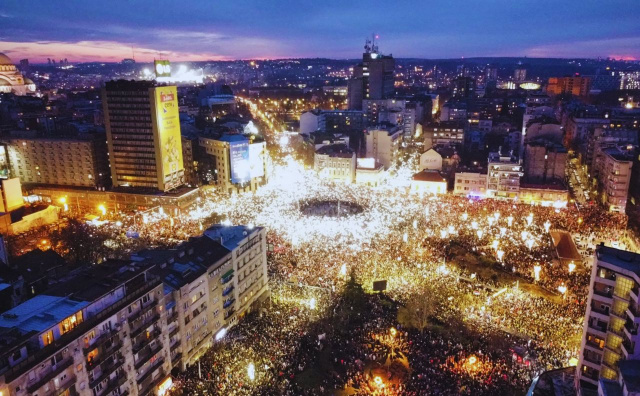
The Balkans experienced a turbulent 2025, with political upheavals, natural disasters, tragic incidents, and social unrest shaping the year. In Serbia, anti-government demonstrations continued following the collapse of a concrete canopy at a Novi Sad train station on November 1, 2024, which killed 16 people, triggering spontaneous protests throughout the year. Turkey witnessed the largest protests in over a decade after opposition figures, including Istanbul Mayor Ekrem İmamoğlu, were arrested, prompting mass demonstrations against President Recep Tayyip Erdoğan. In Greece, delayed farm subsidies caused by a corruption scandal led to farmer protests and blockades of key roads and border crossings late in the year. Romania also saw protests in response to government reforms aimed at controlling the budget deficit, while Croatia experienced an early-year wave of consumer boycotts over high prices, inspiring similar actions across the region.
Natural and human-made disasters marked the year as well. In Greece, an “earthquake storm” struck Santorini and Amorgos in February, with tremors reaching magnitude 5, prompting a state of emergency, school closures, and partial evacuations. North Macedonia suffered a catastrophic fire at a disco in March, killing 63 young people and injuring more than 200. Slovenia legalized assisted suicide in July, only to suspend the law in November following a second referendum where voters rejected the measure.
Key political and judicial events unfolded chronologically. On January 12, Zoran Milanović won a second term as Croatian president with nearly 75% of the vote, after receiving 1,120,832 votes against Dragan Primorac’s 380,038. Croatia’s first shop boycott occurred on January 24, led by the consumer association ECIP through the Facebook group “Hello Inspector,” leaving shops and shelves empty and significantly reducing retail turnover. On January 25, Archbishop Anastasios, head of the Orthodox Church of Albania, passed away at age 95 in Athens.
February was marked by tragedy and legal action. On February 1, a drunk gunman killed 12 people, including two children, in Cetinje, Montenegro, before taking his own life. On February 10, Tirana Mayor Erion Veliaj was arrested on corruption and money-laundering charges, while the Greek parliament elected Konstantinos Thassoulas as president on February 12.
March saw continued upheaval and legal scrutiny. The European Public Prosecutor’s Office opened proceedings against 100 people in Greece for fraudulently claiming €2.9 million in EU subsidies. Albania temporarily banned TikTok for a year following a fatal stabbing linked to the platform. On March 16, the Pulse disco fire in Kocani, North Macedonia, claimed 63 lives, with over 200 injured and some sent for treatment abroad, including to Bulgaria, Greece, Turkey, and Serbia. The trial for this fire began on November 19. Meanwhile, Istanbul Mayor İmamoğlu’s arrest on March 19 triggered mass protests and street riots across Turkey.
Political transitions continued in April and May. Serbia approved a new government under Prime Minister Đuro Măsut on April 16, after the resignation of Miloš Vučević in the wake of Novi Sad protests. Romania held repeat presidential elections on May 4 and 18, after the Constitutional Court annulled the 2024 vote. Nicosor Dan, former mayor of Bucharest and anti-corruption activist, ultimately won the presidency, defeating far-right contender Gheorghe Simion. On May 12, the PKK formally announced its dissolution, ending its armed struggle against Turkey.
June and July brought further developments. Romania formed a four-party government under Prime Minister Ilie Bologian on June 23. In July, the Dubrovnik Summit supported Ukraine’s territorial integrity and EU and NATO integration, while an informal Cyprus meeting in New York, chaired by UN Secretary-General António Guterres, set the stage for talks later in the year. Slovenia legalized assisted dying on July 19 through parliament, applying it only to terminally ill patients with unbearable suffering.
August and September saw Slovenia banning weapons trade with Israel on August 1, while Bosnia’s Republika Srpska president Milorad Dodik was sentenced and removed from office in early August. The U.S. suspended its strategic dialogue with Kosovo on September 12, and Slovenia imposed a travel ban on Israeli Prime Minister Netanyahu on September 25.
In October and November, North Macedonia’s VMRO-DPMNE party won local elections on October 19 and November 2, while Turkish Cypriot leader Tufan Erhurman was elected president in occupied northern Cyprus. Montenegro temporarily suspended visa-free access for Turkish citizens on October 27. A nursing home fire in Tuzla, Bosnia, on November 4 killed 17 people. Albania advanced EU membership talks on November 17, and Slovenia held a second consultative referendum on assisted dying on November 23, which voters rejected. Pope Leo XIV visited Turkey on November 27, marking his first foreign visit as head of the Roman Catholic Church.
The year closed with further unrest and political transitions. On November 30, Greek farmers blocked roads over delayed subsidies. Ethnic Serb mayors took office in four northern Kosovo municipalities on December 5, more than two years after political tensions with NATO peacekeepers. Hristijan Mickoski was re-elected as VMRO-DPMNE leader in North Macedonia on December 6. Finally, on December 7, Cipriani Ciucu of the National Liberal Party won the Bucharest mayoral election, taking office in the Sixth Sector.
The Balkans in 2025 were defined by a combination of social upheaval, natural disasters, political transitions, and judicial actions, with the year marked by tragedy, civic activism, and ongoing regional challenges.
The original article: belongs to Novinite.com (Sofia News Agency) .