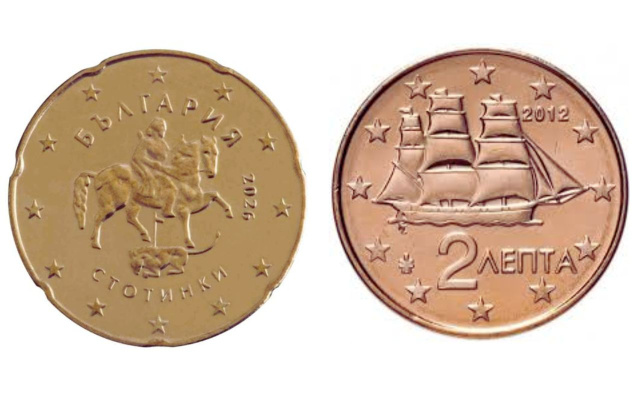
Why Bulgarian and Greek Euro Coins Use Stotinki and Lepta instead of Cents
Source: Novinite.com (Sofia News Agency)
Since the adoption of the euro in Bulgaria, a seemingly small linguistic detail has sparked notable public debate: why Bulgarian euro coins are marked with “stotinki” rather than “cents”. Bulgaria is often presented as a special case, yet it is not entirely alone. Greece has followed a comparable approach, using “lepto” in the singular and “lepta” in the plural instead of the word “cent”.
This choice is neither arbitrary nor a breach of European rules. It reflects a carefully coordinated decision shaped by language norms, cultural continuity and institutional guidance.
EU rules and linguistic flexibility
At European Union level, the framework is clear. The name of the currency itself must be “euro” in all official EU languages. The designation of the smaller unit, however, is treated differently. The European Central Bank allows member states to adapt the term “cent” to their national languages, provided this aligns with established linguistic traditions.
This flexibility creates room for local solutions that respect both the common currency and national language practices.
Why Bulgaria kept “stotinka”
In Bulgaria, preparations for the euro included consultations between the Bulgarian National Bank and the Institute for Bulgarian Language at the Bulgarian Academy of Sciences. Their guidance allows the parallel use of “cent”, “eurocent” and “stotinka” in Bulgarian.
The reasoning is practical rather than ideological. “Stotinka” has long been embedded in everyday speech as the name of the smallest monetary unit. The term predates the modern lev and is familiar across generations. Retaining it with the euro was seen as a way to make prices easier to understand and to limit confusion during the transition.
As a result, the national side of Bulgarian euro coins below one euro carries the inscriptions “stotinka” and “stotinki”. This solution is fully in line with EU regulations and has a clear legal basis.
The Greek example: “lepta”
Greece has taken a similar, though not identical, path. In Greek usage, the hundredth of a euro is called “lepto” or “lepta”, a term with deep historical roots that long predates the euro and was used during the drachma era and earlier periods.
Unlike “stotinka”, which mirrors the concept of one hundredth, “lepta” is not a translation of “cent” but a traditional word for a small denomination. The underlying logic, however, is the same: preserving a familiar linguistic form rather than adopting a foreign term.
The role of non-Latin alphabets
Alphabet choice also plays a role. Bulgarian uses Cyrillic, while Greek relies on its own script. EU institutions allow phonetic and graphic adaptations of currency terms for languages that do not use the Latin alphabet. This explains why Bulgarian officially writes “euro” in Cyrillic (евро) and why directly importing “cent” is less natural.
The same principle applies in Greece. In both countries, the combination of non-Latin scripts, historical usage and linguistic continuity supports the decision to use national terms for the euro’s smaller units.
Continuity over uniformity
Bulgaria’s use of “stotinki” is not an oddity but a clear example of how the euro framework balances unity with diversity. The EU enforces a single currency, not a single language.
There is also a symbolic aspect. Keeping familiar words softens the psychological impact of the currency change. At a time when the euro’s introduction can trigger anxiety and uncertainty, linguistic continuity helps people adapt more easily.
In the end, whether a price is expressed as 50 stotinki, 50 cents or 50 lepta makes no difference in value. The distinction lies in language, and language carries history, habit and identity. That is why Bulgaria and Greece have chosen to retain something recognisably their own within a shared European currency.
The original article: belongs to Novinite.com (Sofia News Agency) .